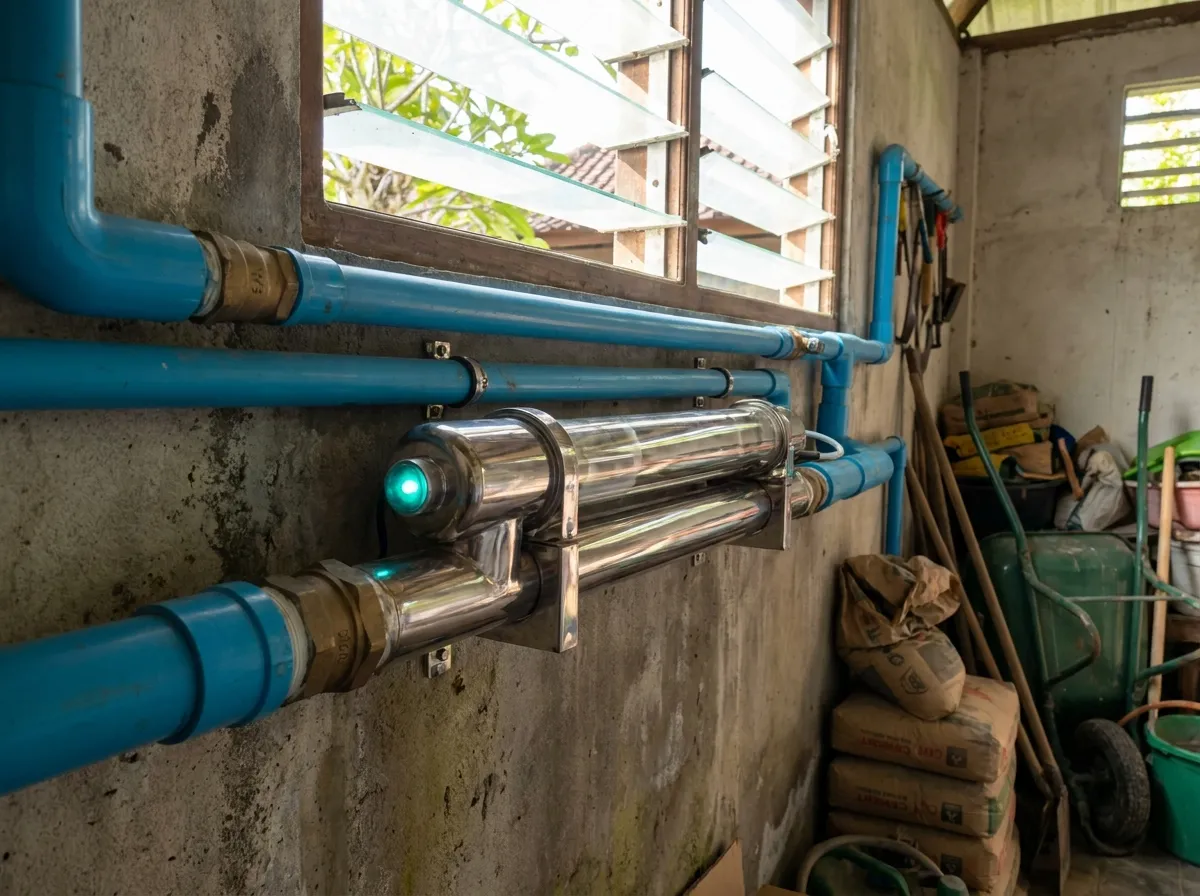
UV sterilisation is the most important water treatment step for Bali's biological contamination risk — and it's often the one omitted. In Bali's tropical conditions, bacteria in well water are a genuine risk that mineral filtration does nothing to address. A standard sediment and carbon filter can produce visually clear water with TDS below 100 ppm that still contains E. coli from agricultural runoff contaminating the aquifer. UV sterilisation uses high-intensity ultraviolet light to disable bacteria, viruses and protozoa by disrupting their DNA — it doesn't add chemicals and doesn't change water taste or mineral content. For any Bali property where drinking water is sourced from a well, UV is the biological safety step.
UV Steriliser Systems
Point-of-Use UV (Under-Sink)
UV unit installed inline at the final stage before the drinking water tap. Provides biological treatment at the point of consumption. Most practical for Bali villas where only kitchen drinking water needs guaranteed biological safety — shower and toilet water is not consumed and UV treatment isn't required for those points.
Whole-House UV
UV unit at the property entry point, treating all water entering the building. Suitable where shower water quality is a concern — children drinking from shower water, for example. Requires higher-capacity UV unit and more frequent lamp replacement than point-of-use.
UV Lamp Replacement
UV lamps degrade over time — output reduces to below effective sterilisation levels at approximately 9,000–12,000 hours of operation (12–18 months for continuous operation). Annual lamp replacement is essential for maintaining effective sterilisation. We supply and replace lamps for all major UV unit brands available in Bali.
UV + RO Combination
The most comprehensive drinking water treatment for Bali: RO removes dissolved minerals and most biological contamination, UV at the post-RO stage provides a final biological safety stage for any organisms that passed the membrane. This combination meets drinking water quality standards from any Bali well water source.
Good to Know
How often does the UV lamp need replacing?
UV lamps degrade over time — output reduces to below effective sterilisation levels at approximately 9,000–12,000 hours (12–18 months of continuous operation). We recommend annual lamp replacement regardless of whether the lamp is still illuminated. A dim or ageing lamp may appear to work while no longer providing adequate germicidal intensity.
Does UV change the taste or smell of my water?
No — UV sterilisation does not add or remove anything from the water. It only affects biological organisms by disrupting their DNA. Water taste, mineral content and TDS are completely unchanged by UV treatment.
Why Biological Risk Is Higher in Bali
Bali's biological contamination problem is driven by two things working together: geology and density. Most villas draw from shallow bore wells, and most properties — including the one next door — dispose of wastewater into septic soak-aways rather than a sewer network. In the porous volcanic and limestone soils of areas like Canggu, Pererenan and Ubud, septic effluent and agricultural runoff migrate into the same shallow aquifer that feeds drinking wells. During the wet season from November to March, rising groundwater and surface flooding accelerate that movement, which is why bacterial counts spike in those months. A clear glass of water from a Bali well can carry E. coli, coliform bacteria and protozoa such as Giardia with no visible warning at all.
UV sterilisation is the most cost-effective answer to that specific risk. The water passes through a chamber where a UV-C lamp delivers a germicidal dose that scrambles the DNA of any micro-organism, leaving it unable to reproduce or cause illness. It adds no chemicals, changes no taste, and runs on a few watts of power. The one rule that matters is lamp maintenance: a UV lamp keeps glowing long after its germicidal output has faded, so we replace lamps annually regardless of appearance and clean the quartz sleeve the lamp sits inside, since scale or sediment on the sleeve blocks the light.
UV is rarely the whole answer on its own. If your source water is also high in dissolved solids, you need reverse osmosis ahead of the UV stage; if sediment is heavy, a whole-house pre-filter keeps the quartz sleeve clear; and hard-water villas still benefit from a softener. Our RO vs UV guide explains where each fits.
Areas Covered
Need UV Sterilisation?
Tell us your current system setup and location. We'll advise where UV fits in your treatment chain and recommend the right unit for your flow rate.
Order in WhatsApp UV Systems