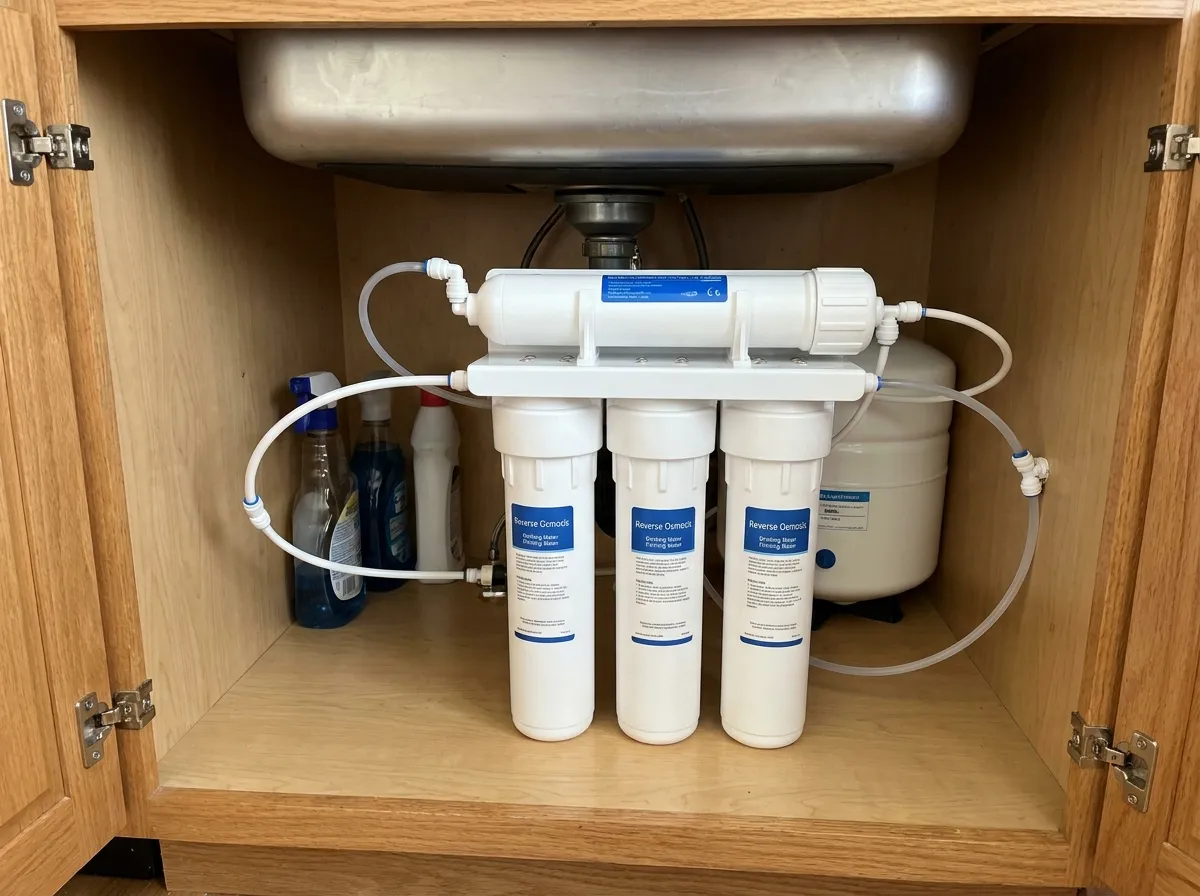
Here is what reverse osmosis actually removes from Bali well water — and why it is different from a standard carbon filter. Most of Bali's villa areas run on deep bore well water with TDS (total dissolved solids) values between 200 and 800 ppm depending on the area. Standard carbon filters reduce chlorine taste, some organic compounds and particulates. They do not remove dissolved minerals, heavy metals or biological contamination. Reverse osmosis forces water through a membrane with pore sizes small enough to exclude dissolved solids — it produces drinking water at 20–50 ppm TDS from 500 ppm source water. For Bali well water, RO is the only technology that consistently produces water meeting WHO drinking water TDS guidelines.
How Reverse Osmosis Works
Water is pushed under pressure against a semi-permeable membrane with pores so fine that water molecules pass through while almost everything dissolved in the water is held back and flushed to drain. "Reverse" refers to the direction: natural osmosis would pull water the other way, so the system uses your mains or pump pressure — sometimes boosted by a small pump — to force clean water across the membrane.
A domestic unit is a 5-stage chain: a sediment pre-filter, two carbon stages that protect the membrane from chlorine, the RO membrane itself, and a final polishing carbon filter on the way to the tap. Treated water is stored in a small pressurised tank, so the dedicated drinking faucet gives instant flow. It is the most thorough point-of-use treatment you can fit in a villa kitchen.
What RO Removes From Bali Water
Because the membrane works at the molecular level, RO removes a far wider range of contaminants than carbon or UV alone. That matters on Bali bore wells, which can carry dissolved metals and salts that other filters simply pass through.
Dissolved metals
Iron, manganese, lead and other metals from volcanic geology or old plumbing are held back at the membrane.
Salts and TDS
Total dissolved solids drop from a typical 200–800 ppm at the source to 20–50 ppm at the tap, including the salt that creeps into coastal wells.
Bacteria and cysts
Membrane pores are far smaller than bacteria and parasite cysts. Where a well tests positive, we still add a UV stage after the membrane as a safety net.
Chlorine and chemicals
The carbon stages strip PDAM chlorine, pesticides and agricultural runoff before the water reaches the membrane and your glass.
RO System Options for Bali Villas
Standard Under-Sink RO (50–75 GPD)
Suitable for a single kitchen tap point serving 2–4 people's drinking and cooking water needs. Includes sediment pre-filter, carbon pre-filter, RO membrane, post-carbon polishing filter and storage tank. Produces approximately 150–200 litres per day with correct feed water pressure. Most common installation for Bali villas.
High-Capacity RO (100–150 GPD)
For rental villas with high occupancy or commercial applications. Higher membrane area and larger storage tank. Suitable where multiple guest rooms need drinking water dispensed from a central kitchen point, or where cooking water demand is high.
Tankless Continuous-Flow RO
Modern membrane designs produce treated water without a storage tank — useful for installations where under-sink space is limited. Slightly higher unit cost but no tank maintenance. Requires adequate feed water pressure (minimum 3 bar) — check your villa's booster pump output before specifying.
Whole-Villa RO (Point-of-Entry)
Large-format RO treating all water entering the property. Expensive to install and operate but eliminates all mineral-related appliance scale issues throughout the villa. Relevant for high-end properties where appliance protection value justifies the higher system cost.
Maintenance in Bali's Conditions
RO system maintenance in Bali requires more frequent filter changes than manufacturer schedules suggest — those schedules assume municipal water quality, not Bali's high-sediment well water. In Bali:
Sediment pre-filter: every 3–4 months (vs. 6 months on clean municipal water). Carbon pre-filter: every 6 months. RO membrane: every 18–24 months in moderate-TDS Bali water, annually in high-TDS coastal or limestone-area water. Post-carbon: annually. We provide a maintenance schedule specific to your source water TDS when installing — not generic manufacturer intervals. The full RO filter and membrane replacement schedule explains each interval and the warning signs between services.
FAQ
Does RO remove all contaminants from Bali well water?
RO removes 95–99% of dissolved solids including minerals, heavy metals, nitrates and most biological contamination. Combined with a UV post-treatment stage, it provides comprehensive protection for drinking water quality from Bali's well sources.
How much does an RO system cost in Bali?
Standard under-sink RO supply and install: IDR 4,000,000–7,000,000 depending on capacity and brand. Annual filter service (pre-filters and carbon): IDR 1,200,000–2,000,000. Membrane replacement: IDR 700,000–1,200,000 every 2 years. See our pricing page for full details.
My Bali villa already has a water filter — do I need RO?
Depends what filter you have. If it's a sediment or carbon filter, it does not remove dissolved minerals or biological contamination. Send us a photo of your current system on WhatsApp and we'll tell you what it does and doesn't remove.
Does an RO system waste a lot of water?
A typical membrane sends two to three litres to drain for every litre of drinking water. Because RO only treats the kitchen drinking and cooking water, the volume is small, and on a private well it costs almost nothing. The reject line can also be run to a garden or greywater point.
Does reverse osmosis remove healthy minerals too?
Yes, along with the contaminants. If you prefer a rounder taste, we add a remineralisation cartridge after the membrane that puts back a small amount of calcium and magnesium.
How We Install an RO System in Your Villa
Our process is the same whether you are in a one-bedroom Berawa villa or a large Uluwatu estate. First we visit and test: we measure your source water TDS and hardness with a calibrated meter so the system is sized to your actual water, not a guess. Many Bali installers skip this and fit a generic 5-stage unit to everything — that is how you end up with a membrane that clogs in six months on high-sediment well water.
Second, we specify the right configuration — under-sink for a single kitchen tap, high-capacity for a rental villa with many guests, or a post-RO UV stage if your well shows biological risk. Third, we install: mounting the unit, connecting to your feed line, fitting the dedicated drinking tap, and plumbing the drain line for the membrane reject water. A standard installation takes two to three hours. Finally, we flush and test the finished water in front of you, so you can see the TDS drop from your source reading down to 20–50 ppm before we leave. You receive a maintenance schedule keyed to your specific water and a WhatsApp reminder when each filter is due.
RO pairs naturally with other treatment. If your whole villa needs sediment and scale protection, an RO drinking tap sits downstream of a whole-house filter; if your well has confirmed bacteria, we add a UV steriliser after the membrane; and in hard-water areas like Ubud and Uluwatu a water softener protects appliances the RO does not reach. Not sure which combination you need? Read our RO vs UV guide or just send us your location.
Areas Covered
Get an RO Quote: Area, Water Source, Number of People
Send those three details and a photo of the space under your kitchen sink. We reply with the right unit size, the installed price and a free test slot.
Get an RO Quote on WhatsApp